Showing posts with label Fackrell. Show all posts

Sunday, October 31, 2010


Lucy Fackrell Grant
1853-1919

On a lovely spring day the 27th of May 1853, six months after Joseph Crumb Fackrell and his wife Clarissa Dempsey had entered the Salt Lake Valley, to settle in Bountiful, they were blessed with a lovely little daughter, whom they named Lucy. She was their fifth child of fourteen, one who died in infancy and one at 3 years old.

At the age of sixteen, her beloved mother became ill with the measles and passed away. Lucy and the rest of the children were also ill in bed with the same illness as their mother, and they were told that if they got out of bed they would die. When Lucy was told that her mother was, no more of this world, she felt she couldn't let her go without one last look at her, so she got up and ran into the room were she was, when she was discovered she was scolded severely.

As soon as Lucy was well she assumed the cares and responsibilities of helping keep together the home for the family. Up to this time she had never mixed and baked a batch of bread, this was because of the hard times and the fear that the bread might be spoiled; also she had been needed to help her father in looking after the geese and the sheep. Seven of the children were younger than herself with the baby being only two years old, she was the eldest daughter living at home at the time, but feeling these duties to be hers, she assumed them willingly, as family and home were always first with her.

A few years later she went into Salt Lake City, where she went to work for a Sister Redfield, who was the mother of the wife of Senator Reed Smoot; she stayed there learning the things that helped her prepare for her marriage and homemaking. She was still there when she made her marriage plans and on the 29th of May 1876, in the Salt Lake Endowment House she married Jedediah Morgan Grant (II). For six years they made their home in Bountiful where three children were born, Alfa born 29 April 1877; J. Morgan Jr. (III) born 11 August 1879; Rossetta Grant born 18 Mar 1881.

Then the family moved onto a cattle ranch on the North Fork of Otter Creek, about five miles out of Randolph, Utah. With them came Lucy's brother Henry Fackrell. While living here five more children were born Joseph Crumb born 29 Apr 1883; Henry Charles born 25 Dec 1884; Estella born 7 Sep 1886; Jemima born 20 Dec 1887 and Lita born 22 Feb 1889. For awhile, while living on the cattle ranch Lucy's brother Jim Fackrell lived with them while he taught school in Randolph. A sadness came to them on the 28 Apr 1887 their six year old daughter Rossetta died.
Due to a drop in the price of cattle they were unable to make the payments on the ranch, so they moved onto a 320 acre farm about two miles out of town. There was a heavy growth of sage brush on the farm when they moved onto it so the children would often be out burning sage brush especially in the Spring of the year. Lucy was always a zealous church worker holding various position in the Religion classes and Sunday School.

When the Woodruff Stake was reorganized she was chosen and sustained as Stake President of the Relief Society. The manner in which she received her calling was rather unusual. A conference was being held at Woodruff, Utah. Her husband, Morgan was away in Oregon, and there was urgent work to be done in the fields, the land had to be cleared of sage brush if there were to be crops planted. Even though it was not women's work, Lucy knew the necessity of helping. She had spent the day in the fields with her boys, when word was sent to her asking that she be at stake conference. She attended and accepted the position of Stake Relief Society President.

When she was set apart for this position, She was given a blessing and was told, that her life's work would be among the sick, and she was promised that if she would go to whatever sickness she was called too, she would never bring the illness back into her home. Her daughter has memories of the many times Lucy went out to take care of any and all illnesses. Some of the illnesses were highly contagious communicable diseases such as Typhoid fever, smallpox, diphtheria, scarlet fever, measles, and etc. Each time upon her return she would go into an old shed. There she would bathe and change her clothes so that she would not bring the illnesses into her home. Truly she was an angel of mercy and her blessing was fulfilled.

While living on the farm two more children were born Austin born 19 Nov 1890 and Wesley Dempsey born 23 Aug 1892. Wesley was the last completing her family of 10 children. Her children were a source of joy and pride to her to the end of her days.

A couple of positions she held were an instructor in the Primary Grade and Ladies Dept. in Randolph, Utah between 22 Dec 1892 and 30 June 1892 another was instructor in a Religion Class in Randolph, Utah between 1 Oct 1897 and 20 June 1889.

In 1897 when the "panic" hit which was blamed on President Grover Cleveland they couldn't make the mortgage and lost the farm.

It takes courage to leave a home and answer a call to assist in colonizing a new country, but Lucy Fackrell Grant had that courage. In 1900, having been called by President Lorenzo Snow and under the direction of Apostle A.O. Woodruff the family gladly responded to leave their home. Lucy's father was concerned about her not wanting to go and came to visit her. She told him yes, that she wanted to go because in the Big Horn Basin her sons might find land on which to build homes. This was the last time Lucy saw her father as he passed away that winter. It took the company four long weeks to make the trip. One of her daughters, who at that time was thirteen years of age, tells that she clearly remembers the day they crossed the South Pass and met two men on horseback. It had been a hard day's travel, for the company had covered only one mile, Lucy and two of her little girls were walking along by the wagon in the mud and slush. The two men on horseback looked pityingly at their struggles and said, "it's a hard trail folks." Such hardships did not discourage them, these very words were typical of Lucy's entire life, "a hard trail,' but she followed it cheerfully.

When they finally arrived in the Big Horn Basin, on the Byron flats, they were met by Apostle Woodruff who after greeting them said, "This Sister Grant, is to be your home." The pioneers who entered the Salt Lake Valley in obedience to President Young's "this is the Place," could not have faced a more barren land or more discouragement. Those of her children describe the place as seeming to be just "Sand and Salt sagebrush." They recalled they could hardly get a meal prepared that wasn't filled with sand. On very hot days when they saw a heavy cloud gather in the southwest, they sometimes thought maybe they would get a heavy rainstorm, but when it got there it would be just dust and they would quickly put everything away in a food box. If it was just a whirlwind and they were eating they would cover everything and wait until it passed before they could finish their meal. For eight months the family lived in a ditch camp, where everyone pitched a tent, lived in their wagons or what have you for shelter while the Sidon canal was being built.

During this time Sister Grant gladly shared with anyone in need. The Grant family was very fortunate in possessing two cows, but the family only used so much, because of the many babies in the camp, it had to be shared with all. One incident in which kindness brings its own reward was when a Mr. Marshall who had been sent from Omaha, to act as a surveyor on the canal, brought his wife and two daughters from the east, there for the summer. They were refined wealthy people of the world, used to every luxury possible of the day and living in places where neighborliness had been forgotten. The Grant family shared milk with them also. At the end of summer, when they were preparing to leave for the east, Mrs. Marshall came expecting to pay for the milk they had received. Sister Grant refused any pay whatever, insisting that she was only too glad to share what they had with others. Mrs. Marshall was very surprised and vowed to repay her in some way. The Grant's rented a farm from Mr. Marshall for one year and then they bought it, which from that time on became her home.

When the family first moved on to the Marshall farm, they found a rather distressing situation a large house stood on the place and part of it was occupied by the family of the tenants of the previous summer. The people who were then on the farm were very much opposed to having anything to do with the so called "Mormon" believing the untruths and tales the world would have them believe. They flatly refused to permit the Grant family to live in the unoccupied part of the house. There was only one thing to do and that was to build a small cabin of their own in another corner of the farm.

Soon after the wife of the tenant became seriously ill with erysipelas, there was no one for miles around to go to their assistance, but Sister Grant, whom they had despised because of her religion, gladly went. For days she devoted every minute of her time in saving the life of Mrs. Tracy and also taking care of the rest of the family. Needless to say, the family had their ideas about "Mormons" changed very suddenly, and from that time on Sister Grant considered Mrs. Tracy one of her most faithful friends.

On the 28th of Oct 1900 organization of the church in the new colony called the Shoshone Branch was established with Byron Session Branch Pres., Jedediah M. Grant First Counselor and W.W. Graham Second Counselor, Mrs. Lucy Grant, Relief Society President. Lucy held this position about one year or until the Big Horn Stake was organized. Sister Grant's home was always open to the weary travelers, and at conference time, it had always been sort of a “headquarters" for conference visitors. Her children relate how many times there was scarcely room to step; so many beds had been made on the floor. Many times Apostle Woodruff, who stayed at the Grant home a great deal of the time would say, "Sister Grant, put these good people up for the night, they're tired and hungry." She never failed to respond to this call. Once again a sadness came to their home when their son Wesley died at the age of 13 with a heart ailment.

Busy helping others; busy rearing her own children, teaching them to follow in her footsteps, the years passed quickly. Lucy was able to see her sons go on missions. In her Patriarchal blessing Sister Grant had been promised that she should live as long as life was desirable to her. Her only desire was that she be permitted to live until she could see her children developed into good men and women and building homes of their own. This dream she saw fulfilled most of her children settled in the vicinity of Lovell. There they raised their families, and happy indeed were the days when the families met together in the old home on the ranch, bringing joy to the hearts of Brother and Sister Grant.

The grandchildren brought joy to the hearts of their grandparents. Many of the grandchildren, who were then little, still speak of the happy visits there. They tell of the wonderful dishes, which no one else could cook just like “Grandma”, and how she let them help her. She taught them other things, such as sewing, knitting, and tatting, leaving many wonderful memories. One Granddaughter, Nelliemae Grant remembers a favorite poem of hers:
Doors like these open with ease,
Two very very little keys,
Two of these are,
I Thank you and If you please.

A Grandson Nolan Grant remembers how she didn't believe in idle hands. She would tell him to go gather sticks and scatter them again if he had nothing else to do.

Sister Grant continued her life of service, always ready to aid in sickness and distress, and never for pay. When the "flu" epidemic which took such a toll, came to the land, she nursed the first victims in her locality, and during the long siege of sickness she went from home to home, helping. One of her grandchildren, who was then a little girl, relates that her only memory of her grandmother was as she stood in the doorway, holding her baby brother, looking in upon the rest of the family who were stricken with the "flu".

The strain of taking care of so many proved to much for her, and a few days later, on the 12th of January, 1919 she, herself succumbed to the flu. At the time of her death she was five foot six and one-half inches tall with brown hair, gray eyes, about one-hundred fifty pounds in weight and sixty-eight years of age. Many mourned her passing her family found it hard to give her up, but somehow it seemed that she would have preferred it that way. On the 13th day of January 1919, she was buried in Lovell, Wyoming. Her mission finished; her life of service completed. She had erected a monument of Love and Mercy unto herself, and her children could truly say, of her, "such a Mother as ours is not dead, but a living Presence."

Thursday, October 21, 2010


Joseph Crumb Fackrell
1822- 1900


Joseph Crumb Fackrell was born at Grafton, Windham Co., Vermont, Sept 9th, 1822, the son of James Fackrell Sr. and Amy Crumb Fackrell, first settlers of West Bountiful, Utah. Little is known of his early life but our records show that he migrated from Vermont to New Hampshire, then to Michigan.


Married Clarrisa Dempsey
Aug. 28th 1845 he married Clarrissa Dempsey at Bertrand, Michigan. She was born in Cayuga Co., New York on the 6th of April, 1824. The birthplaces of the five oldest children show that this couple lived in Michigan, Wisconsin, and Illinois before coming to Utah. In Michigan their home burned and they sought a new one elsewhere.


Conversion
Joseph's father and mother were early converts to the Latter Day Saints Church and they started for the Rocky Mountains with the first companies. After they left, Joseph gave serious thought to Mormonism. He was plowing in the field one day when a member of the L.D.S. Church called to him saying, "Joe, come over to the meeting." He left his horses standing where they were and went to satisfy his curiosity.

The meeting was long but of special interest to Joseph. Someone talked in tongues and the interpretation revealed that Joseph should get to the Valley, the next spring.

A few nights later when lying in bed he saw the place where he was to go in the valley of the Mountains. In the dream he saw his Brother standing near a spring of water holding a team of horses while they drank.

When he told his wife she said she would go with him, and if they found the place he had seen she would join the church. Joseph believed this new religious plan and was soon baptized. They lived near Springfield in Joe Davies Co., Illinois, at the time. They began making preparations to leave their home.


Move to Utah
Joseph Crumb Fackrell, his wife Clarrissa, their four oldest children and the Higgley family (friends of the Fackrell's) traveled west in the Biglow Company in 1852. Joseph took his family to what is now West Bountiful, where he found his brother James standing by a spring holding a team while they drank. His brother, the team, the spring and the surroundings were just as he had seen them in his dream back in Illinois. This satisfied Clarrissa and she became a faithful member of the Church.

Settled in FarmingtonJoseph built a log cabin near the Robert Ure home (1/2 mile west of the D&RGW Depot at Woods Cross) but after a short time they moved to Farmington and built a log cabin on the property now located between the Farmington First Ward Chapel and the County Court House on the east side of the highway. One child was born there. About the fall of 1855 James Fackrell Sr. decided to let his sons take over his farm of 92 acres because he was getting old.

Joseph received the north one third of the farm, located two hundred rods north of the OSL Depot on the Woods Cross road. This land was mostly covered with willows, but was of the most fertile soil in the state. James Fackrell, a son, now living in the old home, remembers helping to take out the willows with a grubbing hoe. It took many years to clear it. In the northeast corner there was a spring that furnished clear cold drinking water and afforded some for the garden. In the late summer the people came with barrels from East Bountiful to this spring to get water.


Testimony building experienceThere was an incident that happened in the lives of Joseph's family that imbedded in them a lasting faith in our Heavenly Father. In 1856 there was a shortage of wheat. The grasshoppers had taken the greatest share, but by rationing there was enough wheat for flour to last them through the winter.

However, when planting time came there was only one half bushel to the acre left to plant. Ordinarily, one & 1/2 to two bushels were planted to assure a good crop. Before the wheat was planted the family knelt and prayed. During the growing season the father, Joseph, went to the field and prayed that the wheat would yield a good crop. When the crop was harvested the yield was good, and as much as was taken off other years with larger plantings.


Johnston’s ArmyIn 1857 Joseph sent his family to Shanghi Bottoms near Lehi and he went to Echo Canyon to meet Johnston's army. This was a time of terrible suspense. Every one was tense with fear and moved quietly for fear of someone who might be lurking near who would hear and interrupt their plans. Joseph was quick and decisive in his actions when his family or Church was in danger. In later years Joseph indicated to his son James a point close to the road in Echo Canyon as the place where the rocks were piled to be rolled down on Johnston's army. When the trouble was over and Johnston's army had encamped at Camp Floyd he took vegetables and flour there and traded them for crackers, arm-chairs, clothing and blankets. Flour sold for $24.00 per hundred.


Sad timesIn 1863 or 1864 he went to meet a Company of Mormon Emigrants. While there he heard of the death of Sister Howard. Upon his return, he brought this sad news to her sons, Bill and Tom Howard, who had come on ahead of the others into the valley. When the sons received this word, they sat for a long time without saying a word. These were very solemn times.

Nursery
Joseph cultivated one of our state's earliest nurseries. He budded fruit trees and raised many kinds of berries. He introduced the first Quince and Greengage to be brought into the state. In 1868 he took a load of fruit trees to Oxford, Idaho.

Wife died
Clarrissa Fackrell contracted measles and passed away July 5th, 1869, leaving Joseph with ten unmarried children to care for. The home, located as it was, was a natural gathering place for young people, so Joseph saw to it that his own and other young people of the community had wholesome entertainment.

He invited them in and they played such games as blind man’s bluff. In the summer they ate watermelons and grapes from his garden. People were often heard to say, "There is someone going to Fackrellzes."

He and some of his sons extended their enterprise to Randolph where they engaged in cattle raising. He was a very good farmer. At one time the Church authorities wanted him to take a responsible position but he thought he wasn't suited for it. He said, "I want to be just plain Joe Fackrell." He had an unusual sense of wit about him. I'll quote from an old letter he wrote to his son:

Letter
"Woods Cross, Davis Co., Utah
Oct. 3rd, 1899
Dear John,
I got your letter, glad to hear from you. We are all well, at least we call it so. Other folks wouldn't. I am busy at work or would have been but it sprinkled a while ago and that excused me. It is now twelve, at least the clock will soon strike, or would but it is a watch and don't strike."

I quote from the history of West Bountiful Ward by Priscilla Muir Hatch, "In 1879 a commencement was made for building a new meeting house on land which Joseph Crumb Fackrell donated and deeded to the Ward for the building of the Church. The present Church and amusement hall now stand on this land. The land also extends north where their lawn and grove are. Not many men in these days were so philanthropic, and it is to be hoped that the people of West Bountiful will give to the memory of Brother Fackrell the appreciation and honor that is due him." He also donated for the Randolph Ward meeting house.

Death
Joseph spent the winter of 1870 & 1871 in Michigan, visiting his wife's relatives. About 1889 he married Grace Holden. He passed away Dec 14th, 1900. (Deseret News clipping) Funeral held Dec. 16th at one p.m. in West Bountiful. There was a large attendance and lengthy cortege. He was an honorable man, and highly respected by all who knew him, was always generous and kind to all he met. Five of his twelve children are still living.
The names of the children follow:
Mary Ann died child 13 Jul 1846 - 16 July 1846
David Edwin married to: Sarah Hanna Barrett
Juliette married to: James Howard
Betsy Jane married to: William Howard
Joseph Norman married to: Sophia E. Fackrell
Lucy married to: Jedediah Morgan Grant
Amy Viola married to: M.M. Brown
James W. (bachelor)
Clarrissa married to: Augustus Sprouse
Alvarette married to: Daniel Corbett
John Dempsey married to: Luella Belcher
William Henry (bachelor)
Estella died child 23 Mar 1865 - 17 Mar 1869
Jemima Ann married to: Peter Clawson

written by Ruth Brown Irving, May 12th, 1941

****************************


Part of a talk given by Joseph Crumb Grant in West Bountiful Chapel on June 18, 1966. Joseph C. Grant was a grandson of Joseph C. Fackrell.

Joseph Crumb Fackrell used to be a successful horse breeder. He owned a ranch out on Bear River on which he raised horses. When I was about 13 years old he gave me the pick of his yearling colts, about 40 in number, because I was named for him, for which I was quite thrilled. Joseph C. Fackrell received the land on the corner, he had joined the Church after his father came to Utah. They followed, settling in West Bountiful in 1852. Joseph was a quiet, unassuming person. He never sought notoriety or high places. He liked to till the soil and deep close to the Lord. Whenever he was given an assignment by the Church he filled it to the best of his ability. He had developed quite a lot of ability and understanding as to how to care for the sick. So he spent quite a lot of time helping people who had sickness. He knew how to use the greatest medicine they had in those days - herbs. He also knew how to put together some valuable poultices for different ailments, which were widely used in those days.


After he joined the Church he built up a definite and implicit faith in God and the Gospel of Jesus Christ. He carried that faith, along with the priesthood he held, into the home where he went, so that he could pray with them and bless them when occasion required it. He was one of those the Master spoke of when he said, "When I was sick ye came unto me." "In as much as ye have done it unto one of the least of these my children ye have done it unto me."


I knew him until I was 19 years old. He had a very kindly disposition. In handling his horses he never mistreated them. As a boy I remember a little incident that happened. He was trying to get a horse to cross a small ditch with some water in it, but the horse just would not step over it. He coaxed and persuaded but it still would not go. Finally he turned to me and said, "Joe will you go across there and swear at that horse." I never heard him swear, so of course he didn't expect me to swear. But he finally got the horse across without mistreatment.


When it came to giving the land to the Church, he had been asked about it and he was thinking and praying about it, (and this story comes to me from his son James W. Fackrell). He was out along the street one night after dark, as he came home he came passed the ground the Ward wanted, just as he came in front of the land, quite a bright light appeared on the walk right in front of him pointing toward the land, he looked at the light then at the land, then he said, "That settles it. The Ward gets the land." Then the light disappeared and he went home and told his son. Then he proceeded the next day to take care of it.

May we appreciate the lives of our pioneer ancestors and the foundation which they laid for us to build on, and may we have the faith and courage to continue to build so that the generations following us, my catch that note of faith and continue to build in faith.

Wednesday, October 20, 2010


Clarissa Dempsey Fackrell
1824-1869

Among the many capable women who came to Utah for their religion was Clarissa Dempsey Fackrell, wife of Joseph Crumb Fackrell. She was born in Cayuga County, New York, April 6, 1824 the daughter of John Dempsey and Betsy White.

When but a child, she moved with her parents and others of her mothers family to Buchanan, Michigan. As she grew up she received her education which was far above the average for those days. She also received some training in nursing and medicine from her cousin, Dr. Jacob White, who lived in Indiana, which proved invaluable to her in after years, not only in her own house but with their neighbors, where she was often called to assist in caring for the sick.

Her family were very strong Methodists. When she was a young girl she met Joseph C. Fackrell and liked him. Because he was a Mormon boy, her family objected to her going with him. She, however, went against their wishes and attended a church dance with him. The family found out about this and was very angry. When she returned home, her clothes were on the doorstep. She was turned out of her home. It was arranged that she stay with one of the church families there in the branch until she and Joseph were married.

She married Joseph Crumb Fackrell the 28 August 1845 in Bertrand, Berrien county, Michigan. They had one daughter Mary Ann born to them in Michigan. She died when 3 days old. They moved to Wisconsin where a son was born David Edwin. A fire destroyed their home and they then moved to Illinois and three children were born to them there.

In the meantime, Joseph's parents and their children had migrated to Utah and Joseph's thoughts were very much with them. He longed to see them and wished to join them. Clarissa, however, did not share his feelings. She had not as yet joined his church.

While plowing in his field, Joseph Fackrell was told by John Boise of a Latter-Day-Saint meeting. They left the horses in the field and went. At this meeting, Joseph Fackrell was told to prepare to leave for the West in the spring. Later, he had a dream. He saw a log house where his father and mother had located in West Bountiful. On the corner of the lot was a beautiful spring of crystal water. His father was standing by the spring with a yoke of oxen. There were green cultivated fields in the valley and snow topped mountains in the background. The dream was so impressive and disturbed him to such an extent that he could not sleep the rest of the night. When Joseph told Clarissa of his dream, she replied, "Joseph, if you believe in this church, I will go with you, but if this dream you've had isn't true, we will return to our people. I will join the church also if your dream is true." At this time they had four children. With a covered wagon, one yoke of oxen, and a few necessities, they started on their journey to Utah. They were six weeks on this trip and came in the Biglow Company, in the spring of 1852. On arriving, the scene that met their eyes was the same as the dream. This impressed Clarissa very much and in six months from the time they arrived she was baptized and spent her life in faithful effort for its betterment.

They settled in West Bountiful until the fall of 1852, leaving there, and going to Farmington where they rented some land and remained for five years.

At the time General Johnson came to Utah with his army to drive the people out of the valley. The family moved south with the body of the people. On their return trip, Clarissa drove the team while her husband and sons drove the cattle. On their wagon was hitched a yoke of oxen and on lead a span of horses. As they were near the Jordan, Utah narrows, there was a very dangerous dugway. In some way the line became entangled around the horns of the oxen, making it impossible for her to guide. This caused them to turn toward the deep ravine. As they were getting dangerously near the edge, she with seven children, three of them sick with Mountain Fever. Susan Fackrell, a sister-in-law, seemed to hear someone say, 'Go back, Susan, Clarissa is in trouble'. Susan went and saw, and with a baby in her arms, ran to the edge of the bank and pulled the lines off the horn of the oxen, thus saving them from overturning and destruction, almost by a miracle, they were saved from an untimely death.

Clarissa was thrifty and industrious. She cut the wool from the sheep's back, took it through the many processes necessary for it to come out in yards of cloth ready to make into clothes for the family. She braided straw and made straw hats. She took her children and traveled to the Lake where she got water, which she boiled down to obtain salt. She bravely withstood the cricket and later the grasshopper devastation.

She often told her children interesting and thrilling events that happened while crossing the planes. One in particular she never forgot: It was when they were crossing a swift stream. The oxen became confused and started downstream and the water became deeper and deeper until her mother held the baby up from her lap to keep it from getting wet. Finally a strange man, passing by on horseback, rode in an succeeded in turning them back and guided them safely to dry land.

Clarissa was the mother of fourteen children. She was of a cheerful disposition and small of stature and was noted for her hospitality. The young people gathered at her home where they sang and enjoyed husking bees, peach cutting and all the entertainment of the time. She helped with the sick where she used her training skillfully and pleasantly.

While they were yet living in their small log house they took a man and his family by the name of Bundy who had no place to stay and shared their room with them until other plans were made.

Sister Maggie Grant often made the remark to Clarissa’s children "No better woman ever came to Utah then Clarrissa Dempsey Fackrell".

On March 17, 1869 her daughter, Estella, almost 4 years old, died. On April 19, 1869 her daughters Julie and Betsy Jane were married to brothers: Julia to James Howard and Betsy Jane to William Howard.

In the summer of 1869 Clarissa’s family contracted measles and, while caring for them, she took the disease herself, and on July 3, 1869, while yet in the prime of her life, she died. She was buried in the Bountiful cemetery.

Clarissa left behind a large family. She was survived by her husband, Joseph, and twelve children who were: David (21), Mrs. Juliette Howard (20), Mrs. Betsy Jane Howard (19), Joseph Norman (17), Lucy (16), Amy Viola (14), James (13), Clarissa (11), Alvarette (9), John Dempsey (8), William Henry (6) and Jemima Ann (1). Two daughters preceded her in death a infant daughter, Mary Ann, and Estella.

It is said that Clarissa never heard from her family after she left Michigan. It was later learned that, on her Mother's death in 1872, she made the family promise that they would find Clarissa in Utah and give her her share of the estate. In later years they did come to Utah to find that she had died before this time. Juliette, her oldest daughter, was given a breast pin and some earrings, which were later given to her daughter, Matilda Howard Johnson.

Some of the above history taken from family information as related by children and relatives. http://freepages.genealogy.rootsweb.com/~rosy/Fackrell/Clarissa.htm And Repository: Fackrell Family Organization archives, c/o Jerald Ross Thompson, 35 West 500 South, Brigham City, UT 84302 (as of August 2001).

Saturday, October 2, 2010


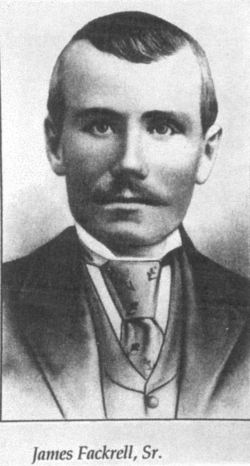
James Fackrell, Sr. 1787-1867
Amy Crumb Fackrell 1799-1886
James Fackrell, Sr. son of John and Joanna Bradford Fackrell of North Petherton, Somersetshire, England, was born at North Petherton, Somersetshire, England, February 2, 1787 and was the third child in his parents’ family which consisted of six children.
At present nothing is known of his childhood. All that is known about his young manhood is that he was a sailor, and that he and his younger brother Richard, were the only members of his family who immigrated to America.
Amy Crumb

Their first residence was in the state of New York. When he was about thirty-two years of age he married Amy Crumb, the twenty year old daughter of Joseph and Prudence Landphear Crumb. Joseph Crumb was born in Rhode Island and Prudence Lamphear was born in Connecticut. Amy, born 14 Sep 1799 was the seventh child in the family of nine children, all of which were born in Grafton, Windham County, Vermont.

ChildrenJames and Amy Crumb Fackrell were the parents of five children, three boys and two girls and from their birth records we conclude that their parents were married in Vermont about 1819 and lived in this place until about 1823. Their first two children were born in Grafton, Vermont. Their first child, David, was born 16 April 1820, and Joseph, the second child was born 9 September 1822. The third child, Betsy Jane, was born 13 November 1824 in Clarendon, Rutland County, Vermont. The last two children were born in Moriah, Essex County, New York, Lucy, 6 July 1826, and James, Jr., 26 April 1829.

Michigan
In 1837 James Fackrell moved his family, which then consisted of himself, his wife Amy, and three boys and two girls, to the state of Michigan and settled in Bertrand, Berrien County, and there lived and prospered in the world's goods until the year 1845.

About 1838 their son David, then 18 years old, ran away from home and went to Wisconsin to live.
On 28 August 1845 their son Joseph married Clarrissa Dempsey, leaving the family with but one son, James Jr. This son was now about sixteen years old and had become interested in religious affairs. He attended camp meetings of the Methodist Episcopal Church, and was converted to this religion and was baptized by sprinkling. He remained in this Church about six months and became very dissatisfied and withdrew his membership.

MissionariesAt this time, two Mormon Missionaries from Nauvoo come to their community and held meetings. James Jr. attended these meetings and became convinced that their doctrine was scriptural, but having been previously "taken in " by the Methodists, decided to wait and see if these new teachings did not "flatten out" and to see if these people "practiced what they preached." His parents were very much opposed to the Mormons and refused to attend the meetings.

The boy James attended, and "the more he heard the better he liked their teachings" and he was desirous that his parents should hear them. He invited the two missionaries, Elder Richard Sprague and an Elder Phelps, to go home with him. After services he took the elders home with him and introduced them to his parents as Mormon Missionaries. Before the missionaries left the home they convinced the parents of the truthfulness of their doctrine and in a short time
James Sr., and his wife Amy, and their daughter Lucy were baptized into the Church of Jesus Christ of Latter-Day-Saints.

Move West
Shortly after this time, news of the martyrdom of the Mormon Prophet, Joseph Smith, and his brother Hyrum, the Patriarch reached the Saints of this place. Also, the message was received from the Twelve Apostles who had taken command of the affairs of the Church, for all saints scattered abroad to gather to Nauvoo and prepare to move west.

Following this advice, James Sr. sold his farm at a sacrifice of about one-half its value and started to Nauvoo. He left their son Joseph and his wife who at that time did not wish to be associated with the Mormons, in Michigan. A great prejudice was manifest against the Mormons and all Saints moving to Nauvoo, and it was with great difficultly that the Fackrell family found lodgings for the nights during their journey. They arrived in Nauvoo the last of March, 1846.
They rented a house and moved into it, and began to look for work. Their stay at Nauvoo was very short, because of the persecution and hardships inflicted upon the saints. They stayed in Nauvoo just three weeks and then started for the West. They knew not where they were going, but they cast their lot with the Saints.
Nothing worthy of note occurred on this journey until they reached Council Bluffs. While in Nauvoo, their daughter Lucy and become ill. She had been exposed to severe storms and cold which proved too much for her delicate constitution, and upon their arrival in Council Bluffs she became very ill.On 20 June 1846 Lucy passed away. This was a severe trial for her family to go through. She was a lovely girl of 20 years, a good Latter-Day-Saint and dearly loved by all who knew her. They laid her body in a grave and with sad hearts turned their faces to new trials.

Winter QuartersShortly after this time the Government called upon the Mormons to furnish 500 men to fight for the United States in suppressing the uprising in Mexico. This left the Saints in dire circumstances. Many did not have roofs to cover their heads or food enough to sustain life.

Those who were left, however, bravely set about preparing for the winter. James and his son built a log cabin in which to move his family. They also went out onto the prairie and cut wild hay for their cattle. The son took a team and went down to Missouri and secured work. For this work he was paid in provisions which amount was enough to last them through the winter.
He brought the provisions home with his team and stayed until the beginning of winter and then left his team and again returned to Missouri but was not so successful in securing work. He returned to Council Bluffs in the spring of 1847 and found the Saints prepared to go west, far beyond persecution, to an unknown land.
The Fackrells were not prepared to take this long journey. They planted a small crop and again James Jr. with his sister Betsy Jane, went to Savannah, Missouri by team where they both secured work. Betsy found work spinning and James secured employment with his team.

They were gone about six weeks and returned to their parents loaded with provisions. James Sr. and his son then set about cutting hay for the winter. They stacked most of it on the prairie, but hauled some few loads home. They cut about 15 tons, but early in the fall the prairie caught fire and burned one stack of about 8 tons. In trying to back fire around the other stack, that one caught fire and burned and they were left with very little hay with which to feed their cattle.
Late in the fall of 1847 some few pioneers who left early in the spring for the west, returned and brought a glowing report of the valley in the Rocky Mountains which they had found and named Great Salt Lake Valley.
The presiding Twelve Apostles then made a call for all Saints to prepare to go back to the valley of the Rockies with them the following spring.

Hay was scarce, and that fall James Jr. took three yoke of oxen to Missouri, partly to provide feed for them, but mostly to make a "fit out" to go west in the spring. He secured work hauling logs to a saw mill and bought corn for ten cents a bushel and fed it to his cattle. In this way his teams were kept in good condition all during the winter. He was also successful in making a "fit out", so when spring came he was well prepared for the journey.
In January of 1848 many of the Mormon Battalion soldiers returned. Among them was George W. Hancock, the young man who commenced courting Betsy Jane Fackrell. The family continued to make preparations to go west to the valley of the Saints.

The Promised LandOn 14 May 1848 George W. Hancock and Betsy Jane Fackrell were married. The next day, 15 May 1848 James Sr. with his wife Amy and their son James Jr. started upon their journey across the plains.

Their journey was uneventful, except for the usual hardships suffered by all pioneers, crossing rivers and traveling over lonely plains and barren hills, until they reached the "promised land" in the valley of the mountains. To them the valley looked dry and barren, but the tired travelers were so weary and footsore that even this looked good to them and they were happy to find a place where they could stop and which they could call home.
Thus the father, the mother and their 19 year old son James established the foundations for the Fackrell kingdom on the mountain tops of Zion.

Settled in Bountiful
They set about at once to prepare for winter. They located a desirable place ten miles north of Salt Lake City, now called West Bountiful, and took up 92 acres of land, which was the first land taken up in Bountiful. According to the historian, Bancroft, James Fackrell Sr., became the first settler in this place.

The family moved their wagon onto the place selected, and the next day James Jr. was taken ill with mountain fever, and was ill about two months.As soon as he was well enough to get about the father and son started to build a house to shelter the family from the winter storms. They worked diligently but were unable to finish the house until the middle of January when they moved in. In the spring they plowed their farm and planted crops, but between crickets and cattle, nothing was harvested.

Family GathersIn October 1849 their daughter Betsy Jane, with her husband and small son, Charles, then a few months old, arrived in the valley and located at Bountiful.

On 8 February 1849, James Jr. was baptized into the Church of Jesus Christ of Latter-Day-Saints by Arvil Cox and on the 13th of January 1850 married Martha Ann Chapman and left his father's home. Thus the parents were left alone.
During the summer of 1850 their oldest son David Fackrell, came into the valley. He was on this way to California and stopped off for a visit. They had not seen each other for 12 years and indeed it was a happy reunion.
Their hearts, however, were soon again bowed in sorrow, for on 28 February 1851, their daughter Betsy Jane, passed through the valley of death to give birth to a baby girl. The mother suffered three weeks and then the new born babe, Betsy Jane Hancock, was left motherless. The little mother of 27 years of age was laid away in the Salt Lake City Cemetery and her old parents and loved ones were left to mourn her loss.
About this time their son Joseph and his wife and family came into the valley. They had recently been converted and joined the Latter Day Saint Church.
Their son David Fackrell prolonged his visit and became converted to the Church also, and was married 6 July 1852 to Susannah Summer. The street, void of an altar served as a Church where their wedding was solemnized.
Susannah Sumner was born in Lancashire, England and there with her parents embraced the gospel. Her father died and she and her mother immigrated to America and came as far west as Saint Louis where her mother died of Cholera. In 1850 she came across the plains with the saints and upon her arrival found a home with James Fackrell Sr., where she met her husband David Fackrell.

David Fackrell did not go to California as he had intended, but took up land in Bountiful and made it his residence.
From these three sons, David, Joseph, and James Jr., a large posterity of Fackrells were produced, which have inherited and inhabited the land of Bountiful for the past six generations.

Later yearsWhen the parents grew feeble, James Jr., built them an adobe house near the meeting house so that they could attend Church more easily. The old people spent the rest of their active lives attending Church and performing ordinances in the Salt Lake Endowment House for their dead ancestors. When they became feeble these aged parents divided their lands between their sons and it was agreed that the sons take care of them their remaining days on this earth.

James Jr. took his father and mother to his home and cared for them until the death of his father.
James Fackrell Sr., was a man of small stature, slight of build, and rather delicate of health, and aged very young.
He was of a kindly, cheerful disposition and was enjoyed and loved by his grandchildren. His wife, Amy, was large, strong and active in body, severe and exacting in disposition.
James Fackrell Sr., died on 21 December 1867, aged 80 years 10 months and 19 days. He was buried in the East Bountiful Cemetery. On his tombstone is written "Blessed are the dead which die in the Lord from henceforth, yea, saith the spirit, that they may rest from their labors and work also."
His wife survived him for 18 years. After his death, Amy moved back to her home in West Bountiful, but she unfortunately fell and broke her hip and soon became feeble. Her children cared for her until her death which occurred on 8 September 1886, aged 85 years 11 months and 24 days.
She was buried by the side of her husband in the East Bountiful Cemetery. Her tombstone says "Her part well done, she goes to rest, in joys of home among the best; a crown of endless life to wear." For nearly a century the Fackrells have lived on the farms of their fathers and grandfathers and still dwell in the homes built by their pioneer forefathers.
Written by Myrtle Ballard Shurtliff in 1936